
National Physical Laboratory receives government funding to progress promising quantum computing technology
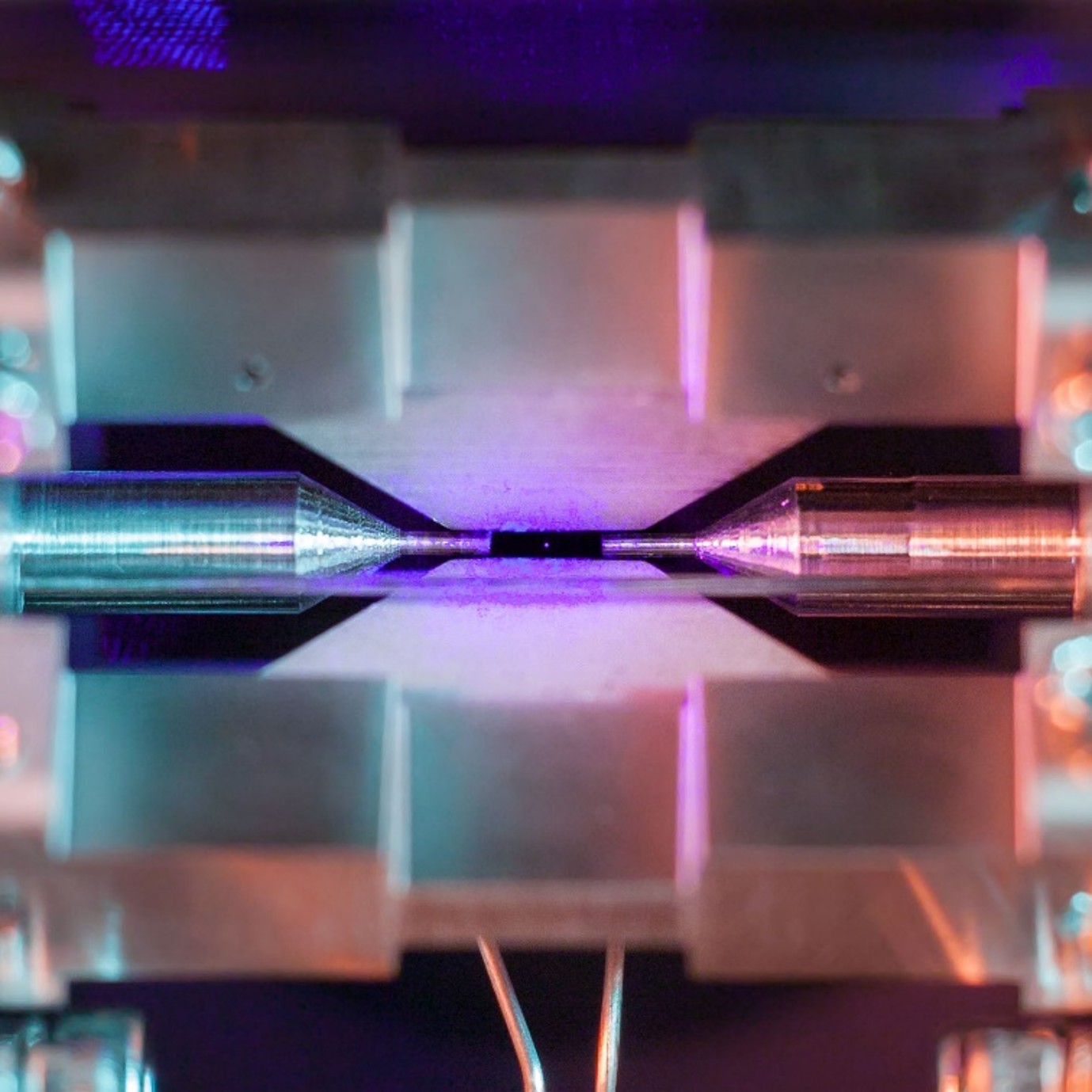
The £230,000 award is specifically targeting accelerated development of quantum ion-traps, one of the key technology candidates for the realisation of large-scale quantum computers.
Scientists at the National Physical Laboratory (NPL) have secured a UK Government Office for Technology Transfer (GOTT) grant to help advance the development of quantum ion-trap systems aimed at addressing scalability issues inherent in prototype quantum computers.
Quantum computing is an emerging technology, but its potential impact is already widely expected to be transformational across many economy sectors. Utilising quantum mechanics phenomena such as superposition and entanglement, fully realised quantum computers will possess unprecedented computational power, unmatched by their classical equivalents and able to address a number of critical issues in e.g. optimisation or molecular simulation necessary in the development of new pharmaceuticals.
There are currently many different approaches to building quantum computers: superconducting circuits (tiny electrical circuits cooled to near absolute zero); photonic systems (using light particles to store and process information); neutral atoms (i.e. atoms with equal positive/negative charges used as quantum bits or qubits); quantum dots or silicon structures(tiny artificial atoms with the capacity to trap single electrons and then use them as qubits); and finally, ion trap platforms which use charged atomic ions suspended in an electromagnetic field as qubits. Using Ion-traps as the fundamental blocks of quantum computers is one of the most promising approaches currently available, as the technology is highly stable in maintaining quantum states for a long period and relatively easy to fabricate. It is also known to achieve high gate fidelities (meaning it is prone to fewer calculation errors)and has networking and scalability advantages.
NPL is already highly active in this field of research having developed a number of ion microtrap devices for projects with the University of Oxford and the National Quantum Computing Centre. This new grant will fund research specifically targeted at addressing existing manufacturing and scalability challenges during the fabrication process. It will specifically support the integration of individual ion traps into networked trapped-ion quantum computing architectures to overcome existing limitations of single-node quantum computers.
Image Source: University of Oxford
SIMILAR News

Who gets to build the future of quantum? An opinion piece by Bharat Pokhrel, Head of Skills, Training and Engagement at the UK Quantum Technology Hub in Sensing, Imaging and Timing (QuSIT)
Heading 1
Heading 2
Heading 3
Heading 4
Heading 5
Heading 6
Lorem ipsum dolor sit amet, consectetur adipiscing elit, sed do eiusmod tempor incididunt ut labore et dolore magna aliqua. Ut enim ad minim veniam, quis nostrud exercitation ullamco laboris nisi ut aliquip ex ea commodo consequat. Duis aute irure dolor in reprehenderit in voluptate velit esse cillum dolore eu fugiat nulla pariatur.
Block quote
Ordered list
- Item 1
- Item 2
- Item 3
Unordered list
- Item A
- Item B
- Item C
Bold text
Emphasis
Superscript
Subscript

Supporting ethical innovation: responsible research and technology development in quantum technologies and the role of the Responsible Quantum Industry Forum
Heading 1
Heading 2
Heading 3
Heading 4
Heading 5
Heading 6
Lorem ipsum dolor sit amet, consectetur adipiscing elit, sed do eiusmod tempor incididunt ut labore et dolore magna aliqua. Ut enim ad minim veniam, quis nostrud exercitation ullamco laboris nisi ut aliquip ex ea commodo consequat. Duis aute irure dolor in reprehenderit in voluptate velit esse cillum dolore eu fugiat nulla pariatur.
Block quote
Ordered list
- Item 1
- Item 2
- Item 3
Unordered list
- Item A
- Item B
- Item C
Bold text
Emphasis
Superscript
Subscript

Quantum Standards Network Community launched to help advance the standardisation of emerging quantum technologies
Heading 1
Heading 2
Heading 3
Heading 4
Heading 5
Heading 6
Lorem ipsum dolor sit amet, consectetur adipiscing elit, sed do eiusmod tempor incididunt ut labore et dolore magna aliqua. Ut enim ad minim veniam, quis nostrud exercitation ullamco laboris nisi ut aliquip ex ea commodo consequat. Duis aute irure dolor in reprehenderit in voluptate velit esse cillum dolore eu fugiat nulla pariatur.
Block quote
Ordered list
- Item 1
- Item 2
- Item 3
Unordered list
- Item A
- Item B
- Item C
Bold text
Emphasis
Superscript
Subscript